


 Tartalomjegyzék
- RULE ONE – THE GAME
- 1. Definitions
- 1.1. Basketball game
- 1.2. Participants’ responsibility
- 1.3. Basket: opponents'/own
- 1.4. Winner of a game
- 1. Definitions
- RULE TWO – COURT AND EQUIPMENT
- 2. Court
- 2.1. Court
- 2.2. Floor
- 2.3. Backcourt
- 2.4. Frontcourt
- 2.5. Lines
- 2.5.1. Boundary line
- 2.5.2. Centre line, centre circle and free-throw semi-circles
- 2.5.3. Free-throw lines, restricted areas and free-throw rebound places
- 2.5.4. 3-point goal area
- 2.5.5. Team bench areas
- 2.5.6. Throw-in lines
- 2.5.7. No-charge semi-circle areas
- 2.6. Position of the scorer's table and substitution chairs
- 3. Equipment
- 2. Court
- RULE THREE - TEAMS B-1
- 4. Teams B-1
- 4.1. Definition
- 4.1.1.
- 4.1.2.
- 4.1.3.
- 4.1.4.
- 4.2. Rule
- 4.2.1.
- 4.2.2.
- 4.2.3.
- 4.3. Uniforms B-1
- 4.3.1. B-1
- 4.3.2.
- 4.3.3.
- 4.4. Other equipment
- 4.4.1.
- 4.4.2.
- 4.4.3.
- 4.4.4.
- 4.4.5.
- 4.1. Definition
- 5. Players: Injury and assistance
- 5.1.
- 5.2.
- 5.3.
- 5.4.
- 5.5.
- 5.6.
- 5.7.
- 5.8.
- 6. Captain: Duties and powers
- 6.1.
- 6.2.
- 7. Head coach and first assistant coach: Duties and powers
- 7.1.
- 7.2.
- 7.3.
- 7.4.
- 7.5.
- 7.6.
- 7.7.
- 7.8.
- 7.9.
- 7.10.
- 4. Teams B-1
- RULE FOUR - PLAYING REGULATIONS A-10 B-29
- 8. Playing time, tied score and overtime B-1
- 8.1.
- 8.2.
- 8.3.
- 8.4.
- 8.5.
- 8.6.
- 8.7. B-1
- 8.8.
- 8.9.
- 9. Start and end of a quarter, overtime or the game B-3
- 9.1.
- 9.2. B-1
- 9.3.
- 9.4.
- 9.5.
- 9.6.
- 9.7. B-2
- 10. Status of the ball A-3 B-3
- 10.1.
- 10.2. B-2
- 10.3. B-1
- 10.4. A-3
- 11. Location of a player and an official
- 11.1.
- 11.2.
- 12. Jump ball and alternating possession B-9
- 12.1. Jump ball definition B-2
- 12.1.1. B-1
- 12.1.2. B-1
- 12.2. Jump ball procedure B-3
- 12.2.1. B-1
- 12.2.2.
- 12.2.3. B-1
- 12.2.4. B-1
- 12.2.5.
- 12.2.6.
- 12.2.7.
- 12.2.8.
- 12.3. Penalty
- 12.4. Jump ball situation B-3
- 12.5. Alternating possession definition
- 12.6. Alternating possession procedure B-1
- 12.6.1.
- 12.6.2.
- 12.6.3.
- 12.6.4. B-1
- 12.6.5.
- 12.6.6.
- 12.1. Jump ball definition B-2
- 13. How the ball is played B-2
- 13.1. Definition
- 13.2. Rule B-2
- 13.3. Penalty
- 14. Control of the ball A-1
- 14.1. Definition
- 14.1.1.
- 14.1.2.
- 14.1.3.
- 14.1. Definition
- 15. Player in the act of shooting A-6 B-5
- 15.1. Definition A-3 B-4
- 15.1.1. A-1 B-2
- 15.1.2. A-1 B-1
- 15.1.3. A-1 B-1
- 15.1.4.
- 15.1.5.
- 15.1.6.
- 15.1. Definition A-3 B-4
- 16. Goal: When made and its value B-1
- 16.1. Definition B-1
- 16.1.1. B-1
- 16.1.2.
- 16.2. Rule
- 16.2.1.
- 16.2.2.
- 16.2.3.
- 16.2.4.
- 16.2.5.
- 16.1. Definition B-1
- 17. Throw-in B-5
- 17.1. Definition
- 17.1.1.
- 17.1.2.
- 17.2. Procedure B-5
- 17.2.1. B-2
- 17.2.2. B-2
- 17.2.3.
- 17.2.4. B-1
- 17.2.5.
- 17.2.6.
- 17.2.7.
- 17.2.8.
- 17.2.9.
- 17.2.10.
- 17.3. Rule
- 17.3.1.
- 17.3.2.
- 17.3.3.
- 17.4. Penalty
- 17.1. Definition
- 18. Time-out
- 18.1. Definition
- 18.2. Rule
- 18.2.1.
- 18.2.2.
- 18.2.3.
- 18.2.4.
- 18.2.5.
- 18.2.6.
- 18.2.7.
- 18.2.8.
- 18.3. Procedure
- 18.3.1.
- 18.3.2.
- 18.3.3.
- 18.3.4.
- 18.3.5.
- 18.3.6.
- 19. Substitution
- 19.1. Definition
- 19.2. Rule
- 19.2.1.
- 19.2.2.
- 19.2.3.
- 19.2.4.
- 19.2.5.
- 19.2.6.
- 19.3. Procedure
- 19.3.1.
- 19.3.2.
- 19.3.3.
- 19.3.4.
- 19.3.5.
- 19.3.6.
- 19.3.7.
- 19.3.8.
- 19.3.9.
- 20. Game lost by forfeit
- 20.1. Rule
- 20.2. Penalty
- 20.2.1.
- 20.2.2.
- 20.2.3.
- 21. Game lost by default
- 21.1. Rule
- 21.2. Penalty
- 21.2.1.
- 21.2.2.
- 8. Playing time, tied score and overtime B-1
- RULE FIVE - VIOLATIONS A-8 B-18
- 22. Violations
- 22.1. Definition
- 22.2. Penalty
- 23. Player out-of-bounds and ball out-of-bounds
- 23.1. Definition
- 23.1.1.
- 23.1.2.
- 23.2. Rule
- 23.2.1.
- 23.2.2.
- 23.2.3.
- 23.1. Definition
- 24. Dribbling
- 24.1. Definition
- 24.1.1.
- 24.1.2.
- 24.1.3.
- 24.1.4.
- 24.2. Rule
- 24.1. Definition
- 25. Travelling
- 25.1. Definition
- 25.1.1.
- 25.1.2.
- 25.2. Rule
- 25.2.1.
- 25.2.2.
- 25.1. Definition
- 26. 3 seconds
- 26.1. Rule
- 26.1.1.
- 26.1.2.
- 26.1.3.
- 26.1. Rule
- 27. Closely guarded player
- 27.1. Definition
- 27.2. Rule
- 28. 8 seconds A-1 B-3
- 28.1. Definition A-1 B-3
- 28.1.1. B-1
- 28.1.2. A-1 B-2
- 28.1.3.
- 28.1. Definition A-1 B-3
- 29. Shot clock A-2 B-1
- 29.1. Rule
- 29.1.1.
- 29.1.2.
- 29.2. Procedure A-2 B-1
- 29.2.1.
- 29.2.2.
- 29.2.3.
- 29.2.4. A-2 B-1
- 29.2.5.
- 29.2.6.
- 29.2.7.
- 29.2.8.
- 29.1. Rule
- 30. Ball returned to the backcourt A-3 B-3
- 30.1. Definition A-1 B-1
- 30.1.1.
- 30.1.2. A-1
- 30.2. Rule
- 30.3. Penalty
- 30.1. Definition A-1 B-1
- 31. Goaltending and Interference A-2 B-11
- 31.1. Definition B-1
- 31.1.1. B-1
- 31.2. Rules A-2 B-10
- 31.2.1.
- 31.2.2.
- 31.2.3.
- 31.2.4. B-4
- 31.2.5.
- 31.3. Penalty
- 31.3.1.
- 31.3.2.
- 31.3.3.
- 31.1. Definition B-1
- 22. Violations
- RULE SIX - FOULS A-7 B-10
- 32. Fouls
- 32.1. Definition
- 32.1.1.
- 32.1.2.
- 32.1.3.
- 32.1. Definition
- 33. Contact: General principles A-7 B-10
- 33.1. Cylinder principle
- 33.2. Principle of verticality
- 33.3. Legal guarding position
- 33.4. Guarding a player who controls the ball A-3 B-4
- 33.5. Guarding a player who does not control the ball
- 33.6. A player who is in the air
- 33.7. Screening: Legal and illegal
- 33.8. Charging A-1 B-1
- 33.9. Blocking A-1 B-2
- 33.10. No-charge semi-circle areas
- 33.11. Contacting an opponent with the hand(s) and/or arm(s) A-1
- 33.12. Post play
- 33.13. Illegal guarding from the rear B-2
- 33.14. Holding
- 33.15. Pushing A-1 B-1
- 33.16. Fake being fouled
- 34. Personal foul
- 34.1. Definition
- 34.1.1.
- 34.1.2.
- 34.2. Penalty
- 34.2.1.
- 34.2.2.
- 34.2.3.
- 34.1. Definition
- 35. Double foul
- 35.1. Definition
- 35.1.1.
- 35.1.2.
- 35.2. Penalty
- 35.1. Definition
- 36. Technical foul
- 36.1. Rules of conduct
- 36.1.1.
- 36.1.2.
- 36.1.3.
- 36.1.4.
- 36.1.5.
- 36.2. Definition
- 36.2.1.
- 36.2.2.
- 36.2.3.
- 36.2.4.
- 36.2.5.
- 36.3. Penalty
- 36.3.1.
- 36.3.2.
- 36.1. Rules of conduct
- 37. Unsportsmanlike foul
- 37.1. Definition
- 37.1.1.
- 37.1.2.
- 37.2. Penalty
- 37.2.1.
- 37.2.2.
- 37.2.3.
- 37.2.4.
- 37.1. Definition
- 38. Disqualifying foul
- 38.1. Definition
- 38.1.1.
- 38.1.2.
- 38.2. Violance
- 38.2.1.
- 38.2.2.
- 38.2.3.
- 38.2.4.
- 38.2.5.
- 38.2.6.
- 38.3. Penalty
- 38.3.1.
- 38.3.2.
- 38.3.3.
- 38.3.4.
- 38.1. Definition
- 39. Fighting
- 39.1. Definition
- 39.2. Rule
- 39.2.1.
- 39.2.2.
- 39.2.3.
- 39.3. Penalty
- 39.3.1.
- 39.3.2.
- 39.3.3.
- 39.3.4.
- 39.3.5.
- 32. Fouls
- RULE SEVEN - GENERAL PROVISIONS B-1
- 40. Foul limits by a player/head coach and game disqualifications
- 40.1.
- 40.2.
- 40.3.
- 40.4.
- 40.5.
- 40.6.
- 41. Team fouls: Penalty
- 41.1. Definition
- 41.1.1.
- 41.1.2.
- 41.1.3.
- 41.2. Rule
- 41.2.1.
- 41.2.2.
- 41.1. Definition
- 42. Special situations
- 42.1. Definition
- 42.2. Procedure
- 42.2.1.
- 42.2.2.
- 42.2.3.
- 42.2.4.
- 42.2.5.
- 42.2.6.
- 42.2.7.
- 42.2.8.
- 43. Free throws B-1
- 43.1. Definition
- 43.1.1.
- 43.1.2.
- 43.2. Rule B-1
- 43.2.1.
- 43.2.2.
- 43.2.3.
- 43.2.4.
- 43.2.5. B-1
- 43.2.6.
- 43.3. Penalty
- 43.3.1.
- 43.3.2.
- 43.3.3.
- 43.1. Definition
- 44. Correctable errors
- 44.1. Correctable errors – General procedures
- 44.1.1.
- 44.1.2.
- 44.1.3.
- 44.2. Correctable errors category 1 – Definition
- 44.3. Correctable errors category 1 – General procedures
- 44.3.1.
- 44.3.2.
- 44.3.3.
- 44.4. Correctable errors category 1 – Special procedures
- 44.4.1.
- 44.4.2.
- 44.4.3.
- 44.4.4.
- 44.4.5.
- 44.4.6.
- 44.4.7.
- 44.4.8.
- 44.5. Correctable error category 2 – Definition
- 44.6. Correctable errors category 2 – General procedures
- 44.6.1.
- 44.6.2.
- 44.1. Correctable errors – General procedures
- 40. Foul limits by a player/head coach and game disqualifications
- RULE EIGHT - REFEREES, TABLE OFFICIALS, COMMISSIONER: DUTIES AND POWERS A-1 B-2
- 45. Referees, table officials and commissioner
- 45.1.
- 45.2.
- 45.3.
- 45.4.
- 45.5.
- 45.6.
- 45.7.
- 46. Crew chief: Duties and powers
- 46.1.
- 46.2.
- 46.3.
- 46.4.
- 46.5.
- 46.6.
- 46.7.
- 46.8.
- 46.9.
- 46.10.
- 46.11.
- 46.12.
- 46.13.
- 46.14.
- 47. Officials: Duties and powers
- 47.1.
- 47.2.
- 47.3.
- 47.4.
- 47.5.
- 47.6.
- 47.7.
- 47.8.
- 48. Scorer and assistant scorer: Duties
- 48.1.
- 48.2.
- 48.3.
- 49. Timer: Duties B-1
- 49.1.
- 49.2. B-1
- 49.3.
- 49.4.
- 50. Shot clock operator: Duties A-1 B-1
- 50.1.
- 50.2.
- 50.3.
- 50.4.
- 50.5. A-1 B-1
- 45. Referees, table officials and commissioner
- APPENDIX A-B-C-D-E-F
- A. APPENDIX A - REFEREES’ SIGNALS
- A.1.
- A.2.
- A.3.
- B. APPENDIX B - THE SCORESHEET
- B.1.
- B.2.
- B.3.
- B.3.1.
- B.3.2.
- B.3.3.
- B.3.3.1.
- B.3.3.2.
- B.3.3.3.
- B.3.4.
- B.4.
- B.4.1.
- B.4.2.
- B.4.3.
- B.4.4.
- B.5.
- B.6.
- B.7. Time-outs
- B.7.1.
- B.7.2.
- B.8. Fouls
- B.8.1.
- B.8.2.
- B.8.3.
- B.8.3.1.
- B.8.3.2.
- B.8.3.3.
- B.8.3.4.
- B.8.3.5.
- B.8.3.6.
- B.8.3.7.
- B.8.3.8.
- B.8.3.9.
- B.8.3.10.
- B.8.3.11.
- B.8.3.12.
- B.8.3.13.
- B.8.3.14.
- B.8.3.15.
- B.8.4.
- B.9. Team fouls
- B.9.1.
- B.9.2.
- B.9.3.
- B.10. The running score
- B.10.1.
- B.10.2.
- B.10.3.
- B.11. The running score: Additional instructions
- B.11.1.
- B.11.2.
- B.11.3.
- B.11.4.
- B.11.5.
- B.11.6.
- B.11.7.
- B.12. The running score: Summing up
- B.12.1.
- B.12.2.
- B.12.3.
- B.12.4.
- B.12.5.
- B.12.6.
- B.13. Head coach's challenge
- B.13.1.
- B.13.2.
- C. APPENDIX C - PROTEST PROCEDURE
- C.1.
- C.2.
- C.3.
- C.4.
- C.5.
- C.6.
- D. APPENDIX D - CLASSIFICATION OF TEAMS
- D.1. Procedure
- D.1.1.
- D.1.2.
- D.1.3.
- D.1.4.
- D.2. Examples
- D.2.1. Example 1
- D.2.2. Example 2
- D.2.3. Example 3
- D.2.4. Example 4
- D.2.5. Example 5
- D.2.6. Example 6
- D.2.7. Example 7
- D.3. Forfeit
- D.3.1.
- D.3.2.
- D.3.3.
- D.3.4.
- D.4. Home and away games (aggregate score)
- D.4.1.
- D.4.2.
- D.4.3.
- D.4.4.
- D.5. Examples
- D.5.1.
- D.5.2.
- D.5.3.
- D.5.4.
- D.5.5.
- D.5.6.
- D.1. Procedure
- E. APPENDIX E - MEDIA TIME-OUTS
- E.1. Definition
- E.2. Rule
- E.2.1.
- E.2.2.
- E.2.3.
- E.2.4.
- E.3. Procedure
- E.3.1.
- E.3.2.
- E.3.3.
- E.3.4.
- F. APPENDIX F - Instant Replay System
- F.1. Definition
- F.2. Procedure
- F.2.1.
- F.2.2.
- F.2.3.
- F.3. Rule
- F.3.1.
- F.3.2.
- F.3.3.
- F.4. Head coach's challenge
- F.4.1.
- F.4.2.
- A. APPENDIX A - REFEREES’ SIGNALS
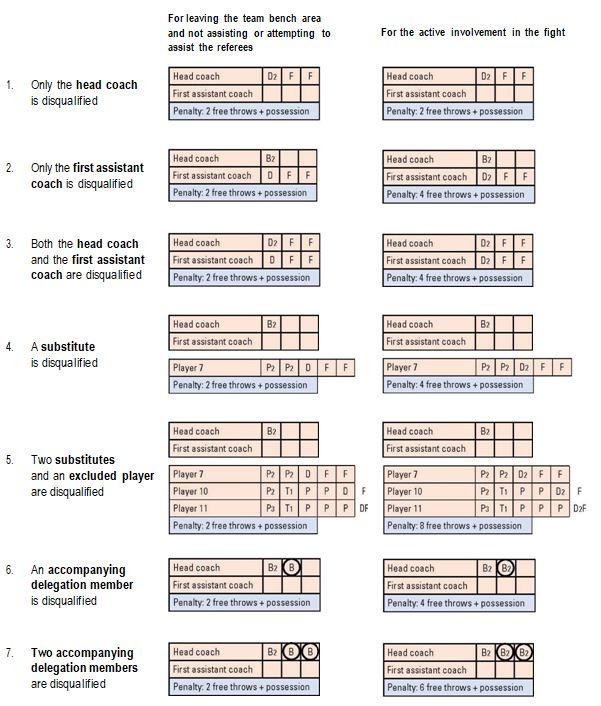
Examples for disqualifying fouls of various persons:
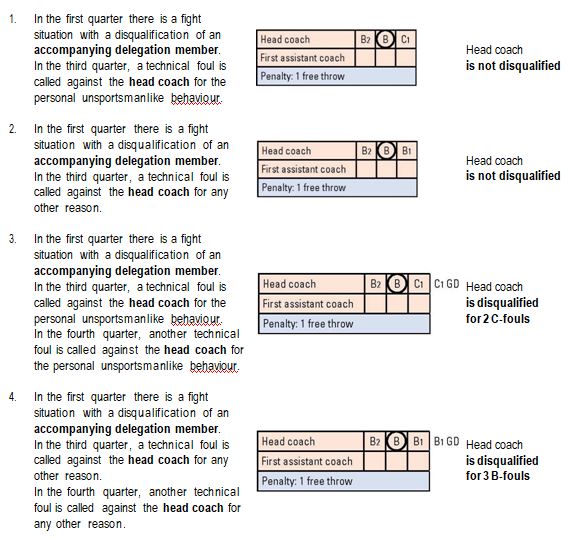
Examples of the technical fouls against the head coach for the personal unsportsmanlike behaviour or for any other reason, combined with the disqualification of an accompanying delegation member for leaving the team bench area during a fight:
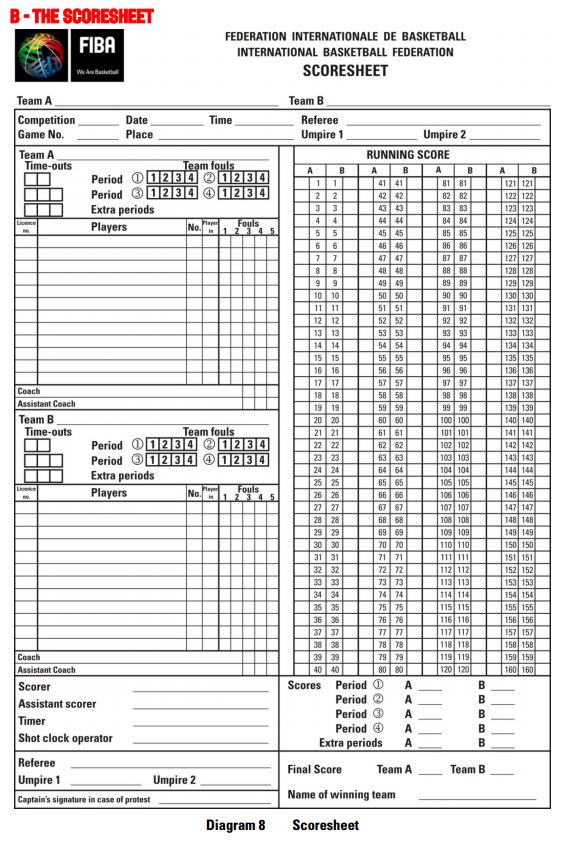
At least 20 minutes before the game is scheduled to begin, the scorer shall prepare the scoresheet in the following manner:
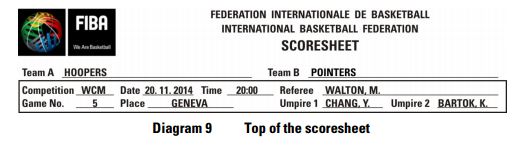
The scorer shall enter the names of the 2 teams in the space at the top of the scoresheet. The team 'A' shall always be the local (home) team or for tournaments or games on a neutral court, the first team named in the
schedule. The other team shall be team team 'B'.
The scorer shall then enter:
• The name of the competition.
• The number of the game.
• The date, the time and the place of the game.
• The names of the referee and the umpire(s).
Team 'A' shall occupy the upper part of the scoresheet, and team 'B' the lower part.
In the first column, the scorer shall enter the number (last 3 digits) of each player, coach and assistant coach licence. For tournaments, the number of the licences shall only be indicated for the first game played by the teams.
In the second column, the scorer shall enter each player's name and initials in the order of the shirt numbers, all in BLOCK CAPITAL letters, using the list of team members as provided by the head coach or the first assistant
coach. The captain of the team shall be entered with a (CAP) immediately after the name.
If a team presents fewer than 12 players, the scorer shall draw a line through the spaces for the player’s licence number, name, number, player in, in the line below the last entered player. If there are less than 11 players, the horizontal line shall be drawn horizontally until reaching the player fouls section and continue diagonally down to the bottom.
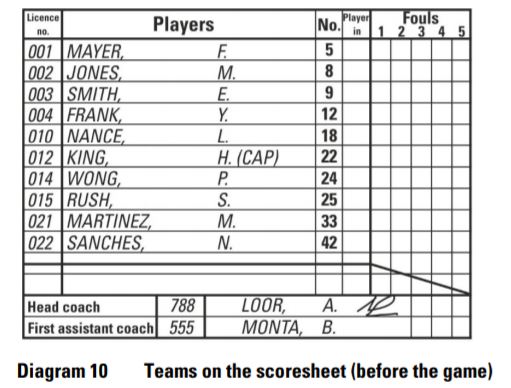
At the bottom of each team's section, the scorer shall enter (in BLOCK CAPITAL letters) the names of the team's coach and assistant coach.
At least 10 minutes before the game is scheduled to begin both coaches shall:
Confirm the agreement with the names and the corresponding numbers of the team members.
Confirm the names of the head coach and first assistant coach. If there is no head coach and no first assistant coach, the captain shall act as player head coach and shall be entered with a (CAP) behind the name.

Enter a small 'x' beside the player's number in the 'Player in' column for the 5 players to begin the game.
Sign the scoresheet.
The coach of team 'A' shall be the first to provide the above information.
At the beginning of the game, the scorer shall circle the small 'x' of the 5 players in the "Player in" column in each team to begin the game.
During the game, the scorer shall draw a small 'x' (not circled) in the 'Player in' column when the substitute enters the game for the first time as a player.
Time-outs granted shall be recorded on the scoresheet by entering the minute of the playing time of the quarter or overtime in the appropriate boxes below the team's name.
At the end of each half and overtime, unused boxes shall be marked with 2 horizontal parallel lines. Should the team not be granted its first time-out before the game clock shows 2:00 minutes in the fourth quarter, the scorer shall mark 2 horizontal lines in the first box for the team’s second half.
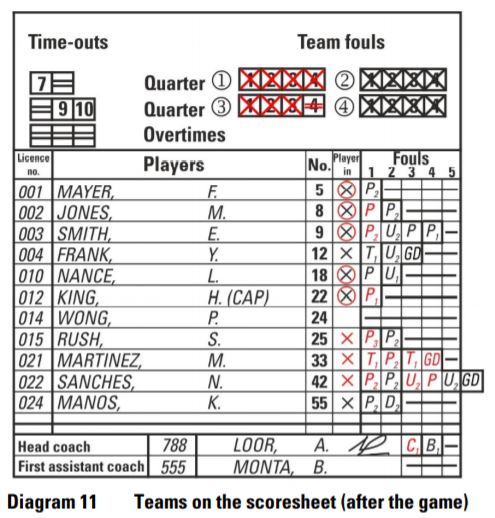
Player fouls may be personal, technical, unsportsmanlike or disqualifying and shall be recorded to the player. In addition, disqualifying fouls committed by persons entered on the scoresheet in a fight shall be entered to these persons.
Fouls committed by the head coach, first assistant coach, substitutes, excluded players and accompanying delegation members may be technical or disqualifying fouls and shall be entered against the head coach. The disqualifying fouls committed by persons entered on the scoresheet in a fight shall be entered against these persons.
All fouls shall be entered as follows:
A personal foul shall be entered as a 'P'.
A technical foul on a player shall be entered as a ‘T’. A second technical foul shall also be entered as a ‘T’, followed by a ‘GD’ for the game disqualification in the following space.
A technical foul on the head coach for the personal unsportsmanlike behaviour shall be entered as a 'C'. A second similar technical foul shall also be entered as a ‘C’, followed by a ‘GD’ in the following space.
A technical foul on the head coach for any other reason shall be entered as a 'B'. A third technical foul (one of them could be a ‘C’) shall be entered as a ‘B’ or ‘C’, followed by a ‘GD’ in the following space.
An unsportsmanlike foul on a player shall be entered as an 'U'. A second unsportsmanlike foul shall also be entered as an ‘U’, followed by a ‘GD’ in the next following space.
A technical foul on a player with an earlier unsportsmanlike foul or an unsportsmanlike foul on a player with an earlier technical foul shall also be entered as an ‘U’ or ‘T’ followed by a ‘GD’ in the next following space.
A player head coach shall be disqualified when committing:
- A technical foul as a coach, entered as a ‘C’ and an unsportsmanlike foul or technical foul as a player, or
- A technical foul as a coach, entered as a ‘B’, a technical foul as a coach, entered as a ‘C’ and an unsportsmanlike foul or technical foul as a player, or
- Two technical fouls as a coach, entered as a ‘B’ and an unsportsmanlike foul or technical foul as a player.
After the last technical foul or an unsportsmanlike foul has been entered, it shall be followed by a ‘GD’ in the following space.
A disqualifying foul shall be entered as a 'D'.
Any foul involving a free throw(s) shall be entered with adding the corresponding number of free throws (1, 2 or 3) beside the 'P', 'T', 'C', 'B', 'U' or 'D'.
All fouls against both teams involving penalties of the same severity and cancelled according to Art. 42 and entered by adding a small 'c' beside the 'P', 'T', 'C', 'B', 'U' or 'D'.
A disqualifying foul on a first assistant coach, substitute, excluded player or anaccompanying delegation member, including for leaving the team bench area in a fight, shall be entered as a technical foul on the head coach by entering a 'B2'.
An ‘F’ shall be entered, after the ‘D2’ or ‘D’, in all remaining spaces of the disqualified head coach, first assistant coach, substitute or excluded player in a fight.
Examples of disqualifying fouls on a head coach, first assistant coach, substitute, excluded player or accompanying delegation member:
A disqualifying foul on a head coach shall be entered as follows:
 A disqualifying foul on a first assistant coach shall be entered as follows:
 A disqualifying foul on a substitute shall be entered as follows:
 and
and
 A disqualifying foul on an excluded player after the fifth foul shall be entered as follows:

and

A disqualifying foul on an accompanying delegation member shall be entered as follows:

Examples of disqualifying fouls for leaving the team bench area in the fight on a head coach, first assistant coach, substitute, excluded player or accompanying delegation member:
Irrespective of the number of persons disqualified for leaving the team bench area, a single technical foul shall be charged against the head coach and entered with a ‘B2 ’ or ‘D2 ’.
A disqualifying foul on a head coach and a first assistant coach shall be entered as follows: If only the head coach is disqualified:
 If only the first assistant coach is disqualified:
 If both the head coach and the first assistant coach are disqualified:
 A disqualifying foul on a substitute shall be entered as follows:
If the substitute has fewer than 4 fouls, then a ‘D’ shall be entered, followed by an 'F' in all remaining foul spaces:
 and
and
.jpg) If it is the substitute's fifth foul, then a ‘D’ shall be entered, followed by an 'F' in the column behind the last foul space:
If it is the substitute's fifth foul, then a ‘D’ shall be entered, followed by an 'F' in the column behind the last foul space:
 and
and
 A disqualifying foul on an excluded player shall be entered as follows:
As an excluded player has no more foul spaces, then a ‘D’ shall be entered, followed by an 'F', both in the column behind the last foul:
 and
and
 A disqualifying foul on an accompanying delegation member shall be charged on the head coach and entered as follows:
 Each disqualification of an accompanying delegation member shall be charged against the head coach, entered as a B , but shall not count towards the three technical fouls for the head coach’s game disqualification.
Examples of disqualifying fouls for his active involvement in the fight on a head coach, first assistant coach, substitute, excluded player or accompanying delegation member:
Irrespective of the number of persons disqualified for leaving the team bench area, a single technical foul shall be charged against the head coach and entered with a ‘B2 ’ or ‘D2 ’.
If the head coach is actively involved in the fight, the head coach shall be
charged with one ‘D’ only, entered as ‘D2 ’.
A disqualifying foul on a head coach and a first assistant coach shall be entered as follows:
If only the head coach is disqualified:
 If only the first assistant coach is disqualified:

If both the head coach and the first assistant coach are disqualified:
 A disqualifying foul on a substitute shall be entered as follows:
If the substitute has fewer than 4 fouls, then a ‘D2’ shall be entered, followed by an 'F' in all remaining foul spaces:
 and
and
 If it is the substitute's fifth foul, then a ‘D2’ shall be entered, followed by an 'F' in the column behind the last foul space:
 and
and
.jpg) A disqualifying foul on an excluded player be entered as follows:
A disqualifying foul on an excluded player be entered as follows:
As an excluded player has no more foul spaces, then a ‘D2’ shall be entered, followed by an 'F', both in the column behind the last foul:
 and
and
 A disqualifying foul on an accompanying delegation member shall be charged on the head coach and entered as follows:
 A disqualifying foul on two accompanying delegation members shall be charged on the head coach and entered as follows:
 Each disqualification of an accompanying delegation member shall be charged against the head coach, entered as a B2 , but shall not count towards the three technical fouls for the head coach’s game disqualification.
Note: Technical or disqualifying fouls according to Art. 39 shall not count as team fouls.
At the end of the second quarter and at the end of the game, the scorer shall draw a thick line between the spaces that have been used and those that have not been used. At the end of the game, the scorer shall obliterate the remaining spaces with a thick horizontal line.
For each quarter, 4 spaces are provided on the scoresheet (immediately below the team's name and above the players' names) to enter the team fouls.
Whenever a player commits a personal, technical, unsportsmanlike or disqualifying foul, the scorer shall record the foul on the team of that player by marking a large 'X' in the designated spaces in turn.
At the end of each quarter, the scorer shall obliterate the remaining spaces with 2
horizontal parallel lines.
The scorer shall keep a chronological running summary of the points scored by each team.
There are 4 columns on the scoresheet for running score.
Each column is divided again into 4 columns. The 2 on the left are for team 'A' and the 2 on the right for team 'B'. The centre columns are for the running score (160 points) for each team.
The scorer shall:
• First, draw a diagonal line (/ for right-handed or \ for left-handed) for any valid field goal scored and a filled circle (•) for any valid free throw scored, over the new total number of points as accumulated by the team that has just scored.
• Then, in the blank space on the same side of the new total number of points (beside the new / or \ or •), enter the number of the player who scored the field goal or the free throw.
.jpg)
It consists of 1 original and 3 copies, each of a different colour of paper. The original, on white paper, is for FIBA. The first copy, on blue paper, is for the organising body of the competition, the second copy, on pink paper, is for the winning team, and the last copy, on yellow paper, is for the losing team. Note: 1. It is recommended that the scorer uses 2 different colours of pen, one for the first and third period and one for the second and fourth period. 2. The scoresheet may be prepared and completed electronically.
A 3-point field goal scored by a player shall be recorded by drawing a circle around the player's number.
A field goal accidentally scored by a player in his own basket shall be recorded as having been scored by the captain of the opponents’ team on the court.
Points scored when the ball does not enter the basket (Art. 31) shall be recorded as having been scored by the player who attempted the shot.
At the end of each quarter or overtimes, the scorer shall draw a thick circle (O) around the latest number of points scored by each team, followed by a thick horizontal line under those points and under the number of each player who scored those last points.
At the beginning of each quarter or overtimes the scorer shall continue to keep a chronological running summary of the points scored from the point of interruption.
Whenever possible, the scorer should check the running score with the visual scoreboard. If there is a discrepancy,
and the score is correct, the scorer shall immediately take steps to have the scoreboard corrected. If in doubt or if
one of the teams raises an objection to the correction, the scorer shall inform the crew chief when the ball becomes
dead and the game clock is stopped.
The referees may correct any error in scorekeeping involving the core, number of fouls or number of time-outs under the provisions of the rules. The crew chief shall sign the corrections. Extensive corrections shall be documented on the reverse side of he scoresheet.
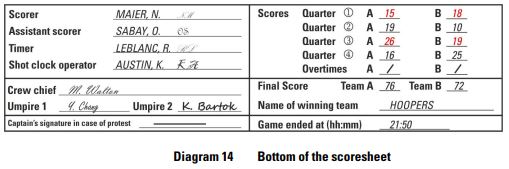
At the end of each quarter and last overtime, the scorer shall enter the score of that quarter and of all overtimes in the proper section in the lower part of the scoresheet.
Immediately at the end of the game, the scorer shall enter the time in the ‘Game ended at (hh:mm)’ column.
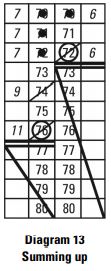
At the end of the game, the scorer shall draw 2 thick horizontal lines under the final number of points scored by each team and the numbers of the players who scored those last points. The scorer shall also draw a diagonal line to the bottom of the column in order to obliterate the remaining numbers (running score) for each team.
At the end of the game, the scorer shall enter the final score and the name of the winning team.
All table officials shall then sign the scoresheet next to their names.
Once signed by the umpire(s), the referee shall be the last to approve and sign the scoresheet. This act terminates the officials’ administration and connection with the game. Diagram 12 Summing up
Note: Should the captain (CAP) sign the scoresheet under protest (using the 'Captain's signature in case of protest'column), the table officials and the umpire(s) shall remain at the disposal of the crew chief until
having the permission to leave.
For games where the Instant Replay System is used each team may be granted 1 head coach’s challenge (HCC). If granted, the HCC shall be entered on the scoresheet below the team’s name in the boxes next to the
HCC. In the first box the scorer shall enter the quarter or overtime (Q1, Q2, Q3, Q4 or OT) and in the second box the minute of the playing time of the quarter or overtime.
At the end of the game, the scorer shall obliterate the unused boxes for the HCC with 2 horizontal parallel lines.