Tartalomjegyzék
- RULE ONE – THE GAME
- 1. Definitions
- RULE TWO – COURT AND EQUIPMENT
- 2. Court
- 3. Equipment
- RULE THREE - TEAMS
- 4. Teams
- 5. Players: Injury
- 6. Captain: Duties and powers
- 7. Coaches: Duties and powers
- RULE FOUR - PLAYING REGULATIONS
- 8. Playing time, tied score and extra periods
- 9. Beginning and end of a period or the game
- 10. Status of the ball
- 11. Location of a player and an official
- 12. Jump ball and alternating possession
- 13. How the ball is played
- 14. Control of the ball
- 15. Player in the act of shooting
- 16. Goal: When made and its value
- 17. Throw-in
- 18. Time-out
- 19. Substitution
- 20. Game lost by forfeit
- 21. Game lost by default
- RULE FIVE - VIOLATIONS
- 22. Violations
- 23. Player out-of-bounds and ball out-of-bounds
- 24. Dribbling
- 25. Travelling
- 26. 3 seconds
- 27. Closely guarded player
- 28. 8 seconds
- 29. 24 seconds
- 30. Ball returned to the backcourt
- 31. Goaltending and Interference
- RULE SIX - FOULS
- 32. Fouls
- 33. Contact: General principles
- 33.1. Cylinder principle
- 33.2. Principle of verticality
- 33.3. Legal guarding position
- 33.4. Guarding a player who controls the ball
- 33.5. Guarding a player who does not control the ball
- 33.6. A player who is in the air
- 33.7. Screening: Legal and illegal
- 33.8. Charging
- 33.9. Blocking
- 33.10. No-charge semi-circle areas
- 33.11. Contacting an opponent with the hand(s) and/or arm(s)
- 33.12. Post play
- 33.13. Illegal guarding from the rear
- 33.14. Holding
- 33.15. Pushing
- 34. Personal foul
- 35. Double foul
- 36. Technical foul
- 37. Unsportsmanlike foul
- 38. Disqualifying foul
- 39. Fighting
- RULE SEVEN - GENERAL PROVISIONS
- 40. 5 fouls by a player
- 41. Team fouls: Penalty
- 42. Special situations
- 43. Free throws
- 44. Correctable errors
- RULE EIGHT - OFFICIALS, TABLE OFFICIALS, COMMISSIONER: DUTIES AND POWERS
- 45. Officials, table officials and commissioner
- 46. Referee: Duties and powers
- 47. Officials: Duties and powers
- 48. Scorer and assistant scorer: Duties
- 49. Timer: Duties
- 50. Shot clock operator: Duties
- A-B-C
- A. A - OFFICIALS’ SIGNALS
- B. B - THE SCORESHEET
- C. C - PROTEST PROCEDURE
- C.1.
- C.2.
- D. D -
- E. E -
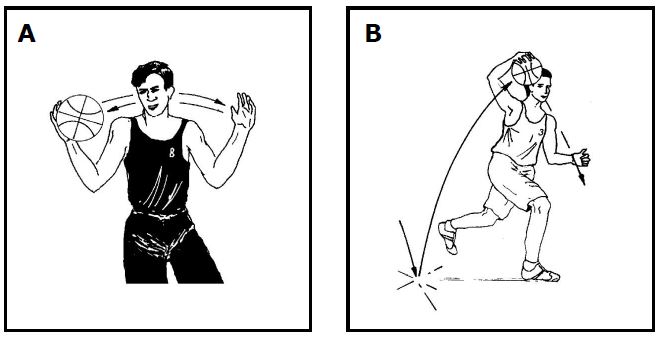
A player may toss or tap the ball from hand to hand providing a travel violation is not committed (diagram A).
The height the ball bounces is not limited during a dribble. Sometimes a player moving quickly pushes the ball too strongly to the floor, it bounces above his head and he tries to continue his dribble (diagram B). This is not an illegal dribble automatically. The only aspect to take into consideration is whether the ball has come to rest in the player's hand(s) or not. If not, his action is legal.
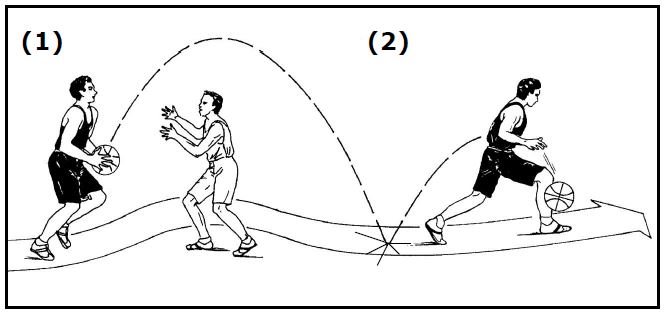
It is legal for a player who is dribbling or holding a ball to tap or throw the ball over an opponent in front of him. If holding the ball, he may not lift his pivot foot before the ball leaves his hand and the ball must touch the floor before the dribbler touches it again. If he does not catch it he may continue his dribble. Remember, during a dribble the ball must meet the floor, and there is no limit to the number of steps a player may take when the ball is not in contact with his hands.
A player deflects a pass, recovers it and starts a dribble. Legal action.
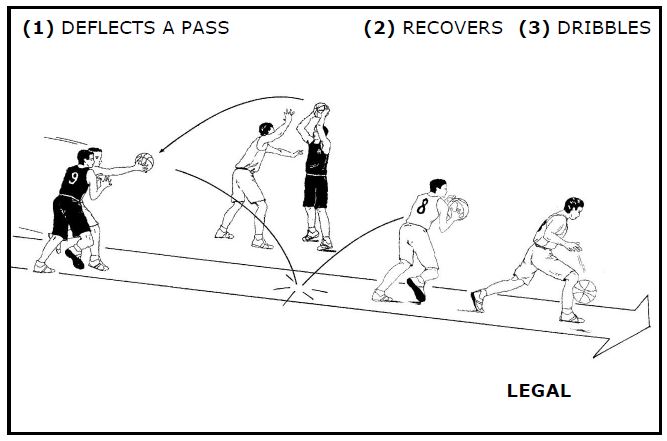
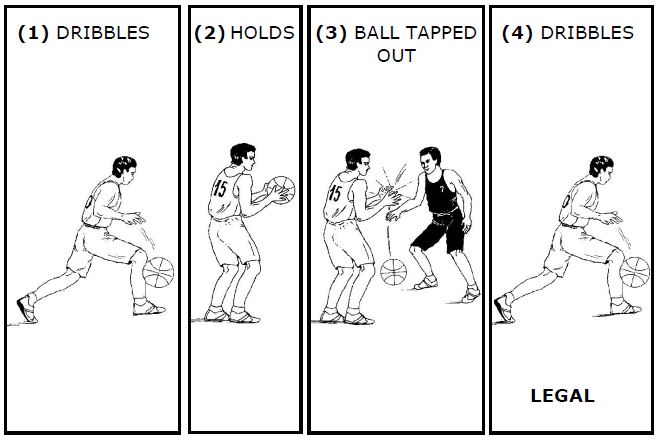
After a dribble the ball is tapped from the player's hand. When he recovers the ball he legally starts a dribble.
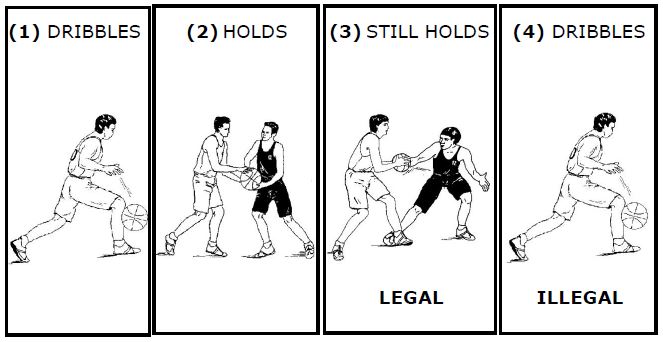
A player ends his dribble. His opponent attempts to take the ball from his hands. The attempt is unsuccessful and the ball remains in the hands of the dribbler. The offensive player may not start a dribble again because the ball has not left his hands. It is a violation if he dribbles again.
FUMBLE
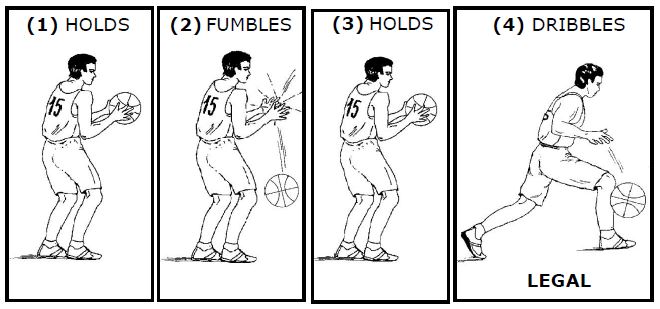
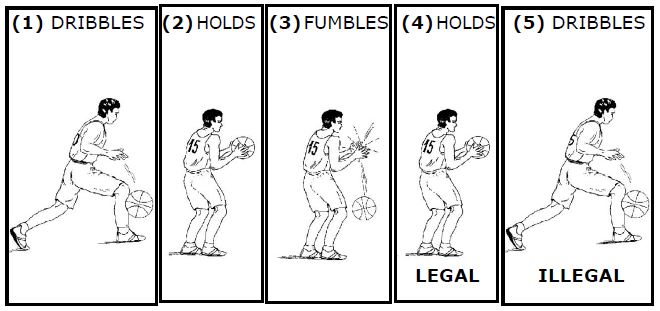
The situation of a fumble causes many problems. It is very important to emphasise that a the fumble is not a dribble. A player may fumble before or after a dribble without committing a violation. However, if after a dribble the player fumbles he may recover the ball but not dribble again. In other words: it is legal if a player fumbles, dribbles, fumbles, but it is illegal if he dribbles, fumbles, dribbles. During a fumble it is not important whether the ball touches the floor or not.
When a player fumbles the ball as he attempts to end the dribble by catching it with one or both hand(s) the player may recover the ball but not dribble again, unless another player has touched the ball.
When a player fumbles the ball before his first dribble, he may dribble after recovering the ball.